

A Deep Dive Into the Physiology of Blood Sugar Metabolism
For many women, fat loss becomes more frustrating with age, not because of lack of effort, but because the biology of metabolism changes.
You may be eating “clean,” exercising regularly, and still noticing:
- Fat gain around the midsection
- Energy crashes
- Strong cravings
- Slower progress despite consistency
At the center of this experience is insulin sensitivity.
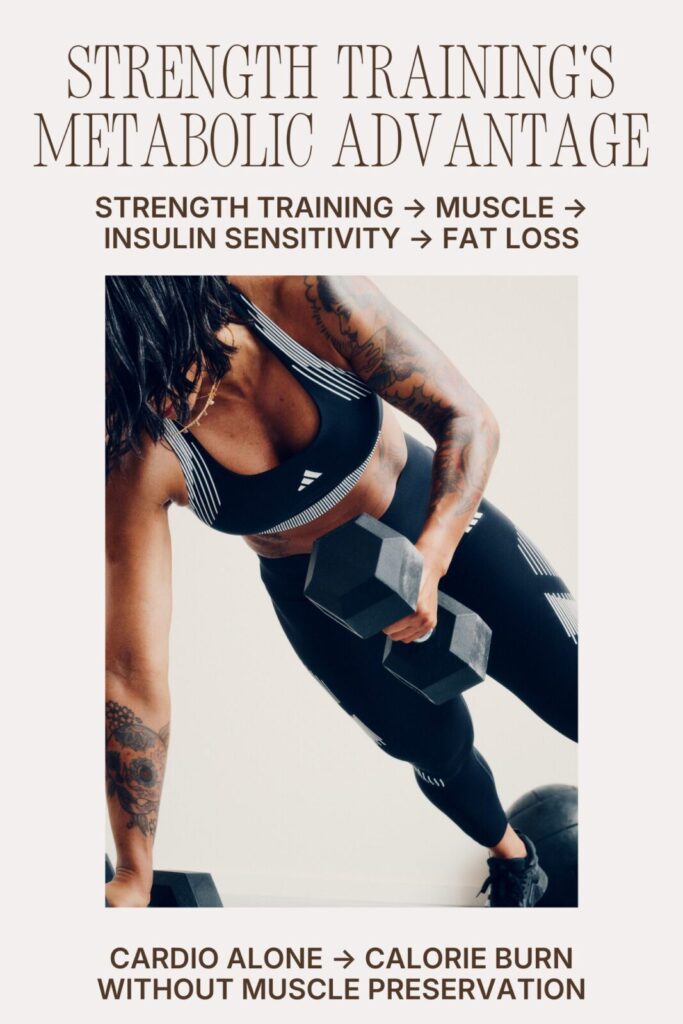
And one of the most powerful tools to improve it is strength training.
Insulin: The Master Regulator of Energy Storage
Insulin is a peptide hormone released by the beta cells of the pancreas in response to rising blood glucose levels.
Its primary functions:
- Facilitate glucose uptake into cells
- Promote glycogen storage in muscle and liver
- Inhibit fat breakdown (AKA “lipolysis”)
- Encourage fat storage when energy exceeds demand
Insulin itself is not harmful.
The problem arises when cells stop responding efficiently—a condition known as insulin resistance.
Insulin Resistance: Why Fat Loss Becomes Harder
When insulin sensitivity is low:
- More insulin is required to move glucose into cells
- Blood glucose remains elevated longer
- Excess glucose is diverted into fat storage
- Lipolysis is suppressed
This creates a metabolic environment where:
- Fat loss stalls
- Hunger increases
- Energy fluctuates
Insulin resistance becomes more common with:
- Aging
- Chronic stress
- Muscle loss (sarcopenia)
- Sedentary lifestyles
This is where skeletal muscle becomes critical.
Skeletal Muscle: The Primary Site of Glucose Disposal
From a physiological standpoint, skeletal muscle is responsible for up to 70–80% of insulin-stimulated glucose uptake.
This happens through:
- GLUT4 transporters embedded in muscle cell membranes
- Insulin signaling pathways that activate glucose entry
The more muscle mass you have, and the more trained it is, the larger your “glucose sink.”
More muscle = more places for glucose to go.

How Strength Training Improves Insulin Sensitivity (Cell by Cell)
1. Increased GLUT4 Expression
Strength training increases both:
- The number of GLUT4 transporters
- Their efficiency
This means muscle cells become better at pulling glucose in, even with less insulin.
2. Insulin-Independent Glucose Uptake
Muscle contractions stimulate glucose uptake without insulin.
This is critical because:
- Glucose can be cleared from the blood even when insulin sensitivity is impaired
- Post-workout glucose handling improves for up to 24–48 hours
3. Improved Mitochondrial Function
Strength training enhances:
- Mitochondrial density
- Oxidative capacity
- ATP production
Healthier mitochondria = better fuel utilization = less glucose being stored as fat.
Strength Training vs. Cardio for Insulin Sensitivity
Cardio has great benefits, but it does not preserve or build muscle to the same degree. So, it’s important to prioritize strength training, while still including cardio in your wellness routine.
Strength training:
- Builds metabolically active tissue
- Improves long-term insulin sensitivity
- Raises resting metabolic rate
- Creates sustained glucose disposal capacity
This is why many women see better fat loss when they shift from cardio-dominant routines to strength-focused training.
Insulin, Fat Storage, and the Role of Muscle
When insulin levels remain elevated:
- Fat breakdown is inhibited
- Stored fat becomes metabolically “locked”
Strength training helps by:
- Lowering baseline insulin levels over time
- Improving insulin signaling efficiency
- Allowing fat to be released and used as fuel
This creates a metabolic environment where fat loss is no longer a fight—it’s a response.
Strength Training and Body Recomposition
One of the most misunderstood concepts is body recomposition:
- Losing fat while gaining or maintaining muscle
Strength training makes this possible by:
- Preserving lean mass during caloric deficits
- Increasing nutrient partitioning toward muscle instead of fat
This is why the scale may change slowly—while measurements, strength, and energy improve dramatically.

Why Strength Training Is a Fat-Loss Strategy
Fat loss is not about burning the most calories in a session.
It’s about how your body handles energy across 24 hours.
Strength training:
- Improves glucose handling
- Lowers insulin demand
- Preserves muscle
- Supports long-term metabolic health
This is especially critical for women over 30, when insulin sensitivity naturally begins to decline.
Training With Intention Matters
Random workouts don’t produce consistent metabolic adaptation.
Structured strength training:
- Balances volume and recovery
- Uses compound, functional movements
- Prioritizes progression without burnout
This is the foundation of sustainable fat loss.
Putting It All Together
All of my programs focus on body recomposition, which is building muscle and losing body fat simultaneously through a sustainable, holistic approach. If you’re a beginner, the Sculpt Foundations program is a great place to start. If you’re intermediate/advanced, the Home or Gym Strength-Focused Program, Volume 1 is for you.
These programs are designed to:
- Build lean muscle
- Improve insulin sensitivity
- Support fat loss without metabolic damage
- Create strength that carries into real life
Fat loss isn’t about punishment, but it’s about working with your physiology, and building muscle is the key. If you would like to learn more about how muscle mass impacts your metabolism, check out the blog “Why Muscle Is Your Metabolic Superpower After 35.”